The Egyptian king who bragged about wiping out Israel
Around 1208 BC, Pharaoh Merneptah carved a boast into granite about the enemies he'd crushed in Canaan. One of the names on the list: Israel.
If you wanted to argue that "Israel" is a late invention — a nation that imagined its own deep past, the way some medieval kingdoms invented royal lineages stretching back to Troy — the obvious move is to ask for the oldest outside reference to the name and see how far back it actually goes. For a long time, the honest answer was: not very far at all. The Old Testament's own claims about a people in Canaan across many centuries were, absent outside confirmation, simply the nation's word about itself.
In 1896, the archaeologist Flinders Petrie excavated a black granite slab, over three metres tall, in the mortuary temple of Pharaoh Merneptah at Thebes. It records a military campaign around 1208 BC, and closes with a list of the enemies Merneptah claims to have crushed in Canaan — cities named Ashkelon, Gezer, Yanoam. Then, among them, a name written with a determinative marking it not as a city or a territory, but as a people.
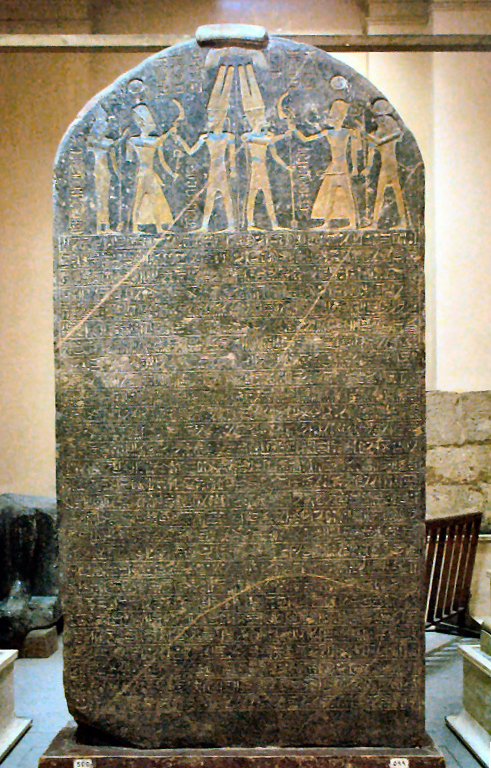
"Israel is laid waste, its seed is not"
The line reads, in the scribal boasting of Egyptian victory monuments: "Israel is laid waste, its seed is not." It is the earliest known occurrence of the name Israel outside the Bible, by a margin of centuries — a hostile empire's own propaganda, treating Israel as an already-established people in Canaan, worth naming in the same breath as cities and kingdoms.
Merneptah was not being generous. Egyptian victory inscriptions exist to inflate a pharaoh's glory, and this one almost certainly overstates the actual damage done — Israel obviously was not wiped out. But an inscription does not need to be honest about the outcome to be honest about who was there. You do not brag about annihilating a people who don't exist. The boast only works, rhetorically, if everyone reading it already knows Israel is a real presence in Canaan worth being seen defeating.
What this settles, and what it can't
This does not confirm the Exodus, the conquest under Joshua, or any specific event in the biblical account of how Israel came to be in Canaan. Scholars still argue fiercely over how and when Israelite identity formed there, and this stele does not resolve that debate. If anything, its early date sharpens the argument, since it shows Israel was already a recognized entity in Canaan by 1208 BC — earlier than some reconstructions of Israelite origins comfortably allow.
What it does settle is narrower, and still significant. Whatever else "Israel" would become — a kingdom, a divided kingdom, an exiled and returning people, the nation the rest of the Old Testament is about — the name itself is not something biblical writers invented centuries later and projected backward. An Egyptian scribe, with every incentive to lie about the outcome and none to invent the target, carved the name in granite more than three thousand years ago, in the very land the Old Testament claims for it.
The stele proves a name and a location, not a theology. But naming is where every historical claim has to start, and on that point the oldest witness we have — a hostile one, boasting in stone about a victory it never actually won — agrees with the book it never read.
New writing every weekday, and a chapter of Scripture every morning.
Get The Morning Proof