The bone box of the man who condemned Jesus
Caiaphas sentenced Jesus to death and then vanished from history — like every other ancient official. Then a bulldozer broke into his family tomb.
Of all the people named in the Passion narratives, one had the most reason to disappear from history without a trace. Caiaphas held the office of high priest in Judea for eighteen years — an unusually long tenure that suggests a man skilled at working the Roman system that appointed and removed high priests at will. Like almost every other official of the ancient world, he should have ended up in an unmarked grave, known to history only through whatever his enemies happened to write down.
For nineteen centuries, that is exactly what happened. Josephus names him. All four Gospels name him, presiding over the council that sent Jesus to Pilate. And then nothing — no monument, no inscription, no physical trace of the man at the center of the trial.
In November 1990, construction crews building a water park in Jerusalem's Peace Forest broke through the roof of a first-century burial cave nobody knew was there. Inside, archaeologists found twelve limestone ossuaries — the bone boxes Jewish families used to gather a body's bones a year or two after burial, once the flesh had decayed. One of them, the most ornately decorated box in the cave, carried a name scratched twice into its side.
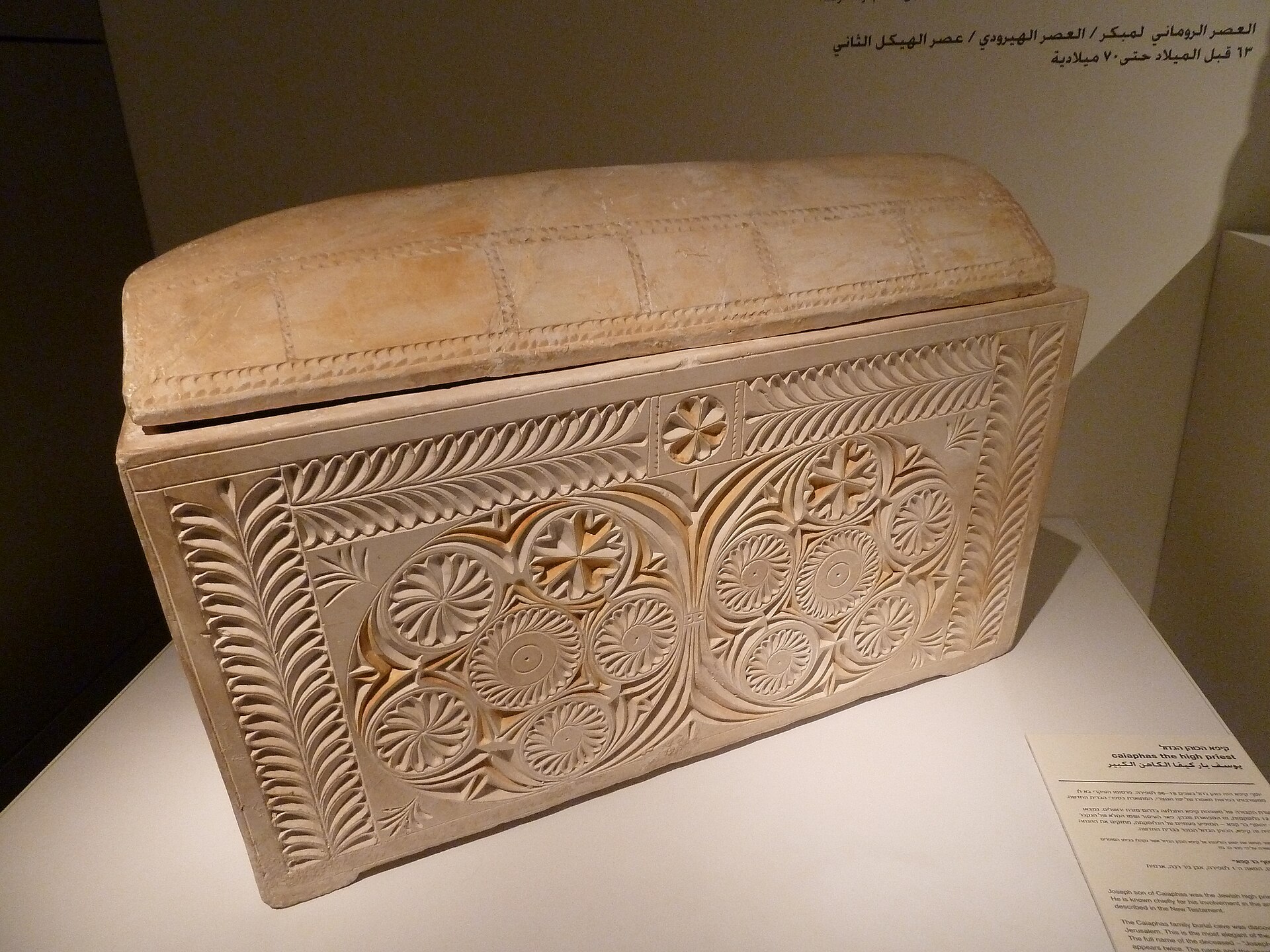
A name history had already given us
The inscription reads, in Aramaic, "Joseph, son of Caiaphas." Josephus had already told us the high priest's full name was Joseph, called Caiaphas — a detail that would be easy to dismiss as a minor flourish until it turned up, independently, carved into a box holding an actual man's bones. Inside were the remains of six people, including a man of about sixty, roughly the age Caiaphas would have reached decades after the trial the Gospels describe.
Notice what this does and does not establish on its own. It does not prove beyond dispute that this particular Joseph is the Caiaphas of the Gospels — a minority of scholars have raised the fair caution that Caiaphas may have been a family name shared by others in the period. But the tomb's location outside Jerusalem, its wealth, its first-century dating, and the rarity of the exact name combination have persuaded most archaeologists working the find that this is the family tomb of the man who ran Jesus's trial. The Israel Antiquities Authority, no friend of overclaiming, treats the identification as the leading explanation.
The man who disappears from every other record
What makes the find unusual is not only the name. It is what the discovery does to a figure who, by the ordinary rules of ancient history, should have been unrecoverable. Officials like Caiaphas left no autobiographies, commissioned no victory monuments, built nothing bearing their own names for later ages to dig up. He is exactly the kind of person historians expect to lose entirely — a powerful bureaucrat in a small, unglamorous Roman province, one of thousands who left no trace.
And yet there he is, in his own family tomb, on a box built to hold his bones, decorated in a style that matches the wealth Josephus describes his household enjoying. It is a strange kind of intimacy: a name from a courtroom scene two thousand years old, resting where an actual family placed it, in a hillside a few miles from where the trial is said to have happened.
What the bone box does and does not prove
Here is the limit, stated as plainly as it deserves. An ossuary bearing Caiaphas's name does not confirm a single line of dialogue attributed to him in any Gospel. It does not prove the trial unfolded exactly as narrated, or that any particular verdict was reached in the room the text describes. Bones prove a life and a death. They do not adjudicate a hearing.
What it does is remove one more name from the list of characters skeptics have called literary conveniences. The high priest who, according to John, told his council it was better for one man to die for the people than for the whole nation to perish was not an invention built to carry a plot forward. He was a man with a household, a family tomb, and bones that a hillside outside Jerusalem kept for two thousand years until a construction crew found them.
Every name recovered this way narrows the same argument by the same amount — not proof of the story, but proof that the story is set inside a real world, populated by real people, one of whom kept, of all things, his own bones close enough to be found.
New writing every weekday, and a chapter of Scripture every morning.
Get The Morning Proof