The clay cylinder that names the king Isaiah predicted
Isaiah named Cyrus as Israel's liberator roughly a century and a half before Cyrus was born. Then archaeologists found Cyrus's own account of a policy that matches it.
Among the boldest claims in the Old Testament is not a prediction of an event but a prediction of a name. In Isaiah 44 and 45, the text names a specific foreign king, generations before his birth, and states plainly what he will do: end Judah's exile, and issue the order to rebuild the temple in Jerusalem. The king is Cyrus. At the time the words were set down, Persia had not yet conquered anything, and would not exist as an empire for roughly a century and a half.
Skeptics have a ready answer for this, and it deserves to be stated rather than dodged: most critical scholarship dates the second half of Isaiah to the exile itself, precisely because it names Cyrus so specifically — on that view, the prophecy is history recorded just after the fact, not prediction written centuries before. That is a serious position, and this site has addressed the authorship question elsewhere. It is not the subject here.
This piece is about something narrower and independently checkable: did Cyrus actually do what both the biblical text and, on any dating of Isaiah, the exile narrative say he did? For that question, you don't need Isaiah at all. You need Cyrus's own words.
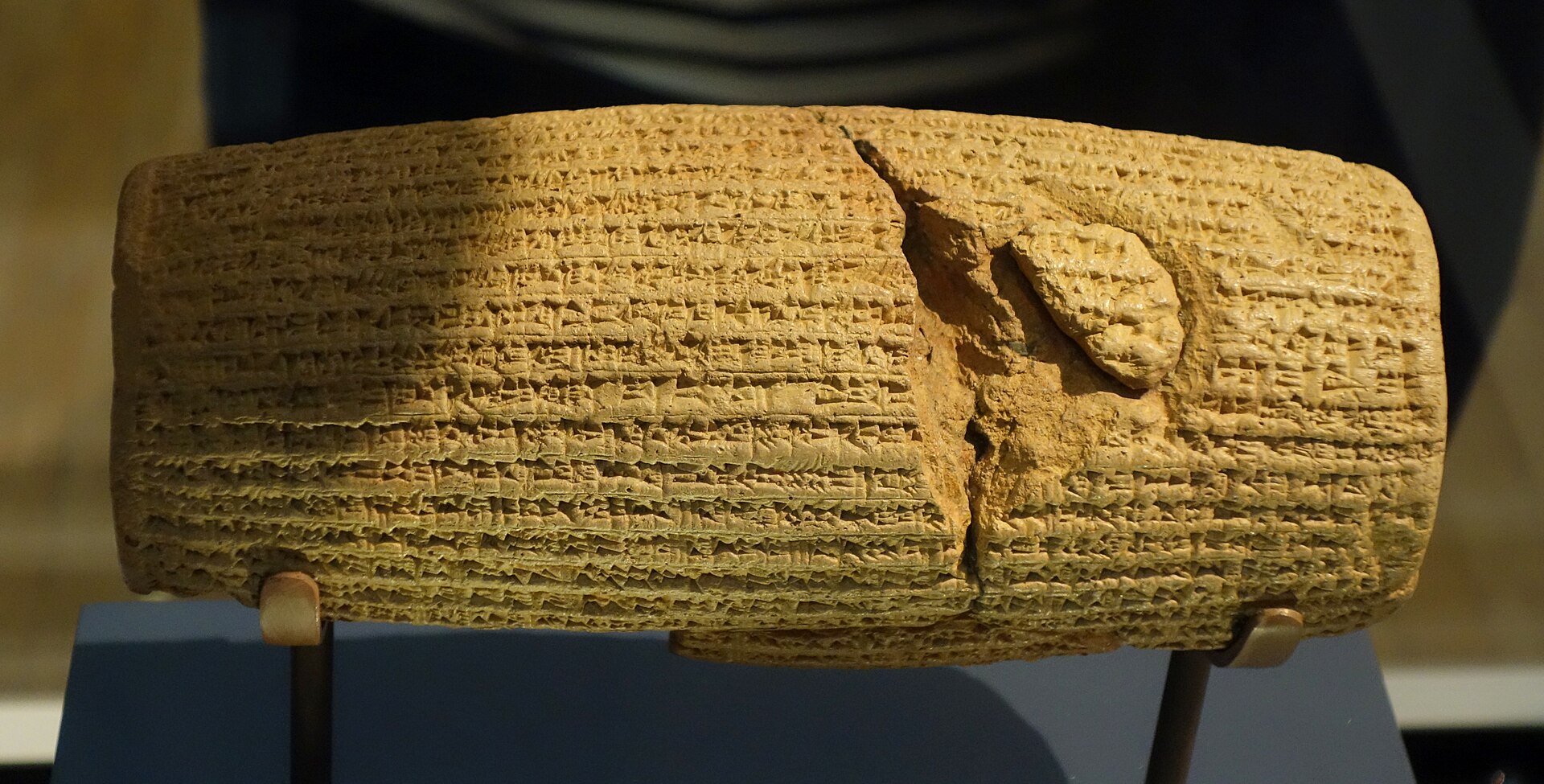
In 1879, the archaeologist Hormuzd Rassam excavated the foundations of the Esagila temple in Babylon and uncovered a barrel-shaped clay cylinder, covered in cuneiform, buried there deliberately as a foundation deposit when Cyrus took the city in 539 BC.
A policy, in the king's own words
The cylinder is Cyrus's own royal inscription, composed by his scribes to be sealed into a wall — never intended for a Judean audience, or any audience beyond the gods and posterity. In it, Cyrus describes gathering peoples that previous Babylonian kings had displaced and sending them home, restoring their sanctuaries. It is a policy statement, not a scripture, and the surviving text does not name every captive nation it applied to — Judah is not mentioned on the cylinder itself.
That point matters and should not be smoothed over. The Cyrus Cylinder does not mention Jerusalem, Judah, or the Jewish exiles by name. What it establishes, independently of any biblical claim, is the policy: Cyrus, immediately upon taking Babylon, adopted and publicized a practice of returning displaced peoples to their homelands and permitting the restoration of their temples — an explicit break from the deportation policies of the empires before him.
The book of Ezra records the specific application of that general policy to Judah: a decree, in Cyrus's first year, authorizing the exiles to return and rebuild the house of the Lord in Jerusalem. No copy of that specific decree has surfaced in Persian archives. What has surfaced is the cylinder proving the general policy it claims to apply — an administration that, on the clearest evidence we have from Cyrus's own hand, behaved in exactly the manner Ezra describes toward exactly this kind of subject people.
What the clay proves, and what it doesn't
Be precise about the limit. The cylinder does not prove Isaiah's prophecy was written before Cyrus existed — that argument rests on manuscript dating and the Dead Sea Scrolls, covered elsewhere on this site, not on Babylonian clay. And it does not, by itself, confirm the Judah-specific decree in Ezra word for word; Judah's name is not on the surviving cylinder text.
What it proves is that the king Isaiah names is not a figure invented after the fact to fit later history in every particular. Cyrus's own administration really did run the kind of program the exile narrative depends on, publicized in his own words, on an object he had sealed into a temple wall for reasons that had nothing to do with Judah's God. Whatever the resolution of the authorship debate, the world the text describes — a Persian king who frees captive nations and rebuilds their gods' houses — is the world Cyrus's own scribes describe him building.
A name recorded, a policy confirmed, and a decree still missing from the archives. That is an honest inventory of what the evidence holds — not a closed case, but a closer one than a name plucked from thin air has any right to be.
New writing every weekday, and a chapter of Scripture every morning.
Get The Morning Proof