Isn’t the Bible just a copy of a copy of a copy?
The “telephone game” objection: two thousand years of hand-copying, so how could a word survive? It sounds obvious. The comparison quietly breaks.
You have heard the objection, maybe made it yourself. The Bible was copied by hand for two thousand years, copy of a copy of a copy, like the children's game of telephone — a sentence whispered down a line until it comes out the other end as nonsense. By the time it reached us, how could a single word be trusted?
It is a good objection. It sounds decisive. And it falls apart the moment you look at how the copying actually worked — the comparison is wrong in every part that matters.
Why telephone is the wrong picture
Take the telephone game seriously for a second, because its whole design is the opposite of manuscript copying.
In telephone, the goal is to garble — the game exists to produce a funny error. Scribes copying Scripture were trying to do the reverse: to reproduce the text exactly, often believing they were handling the words of God, checking their work and having others check it.
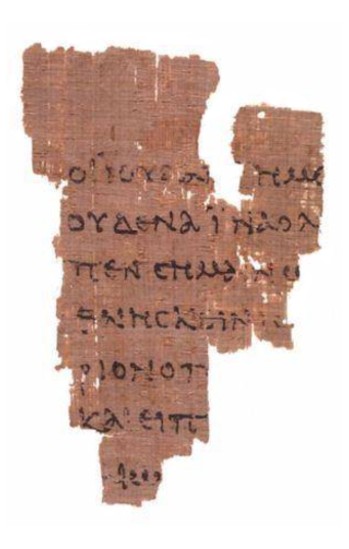
In telephone, there is one line. Each person hears only the person before them. But the New Testament did not travel down a single chain — it branched, copied in Egypt and Syria and Rome and Gaul, many independent lines spreading out at once.
In telephone, it is spoken, heard once, gone. Scripture was written — sitting in front of the scribe to be copied and re-checked against.
And the decisive difference, the one that ends the analogy: in telephone you can only ask the last person in line what they heard. But textual critics are not stuck with the last copy. They can lay hundreds of manuscripts side by side, from many centuries and many places, some reaching back very near the originals. The scholar Daniel Wallace puts it well — it is as if, instead of hearing only the whisper in your own ear, you could listen in on what was whispered to everyone in the circle. Play telephone that way and the game becomes trivially easy to win.
But aren’t there hundreds of thousands of variants?
Yes — and this is where honesty matters, because the number is real and skeptics cite it correctly. There are more differences among the New Testament manuscripts than there are words in the New Testament. Hundreds of thousands of variants. That sounds catastrophic.
Here is what that number actually means, and it is not what it sounds like. The variant count is huge because the manuscript count is huge. We have more copies of the New Testament than of any other ancient text by an enormous margin — and more copies mechanically produce more recorded disagreements. Abundance generates variants. It is a by-product of having a lot of evidence, not a lot of corruption.
And the kind of variant is the whole story. The overwhelming majority are trivial: spelling differences, slips of word order, an obvious dropped letter — the ancient equivalent of a typo, and just as easy to spot. By Wallace's estimate, the variants that are both meaningful and genuinely in doubt come to less than one percent.
The witness from the other side
Do not take a believer's word for the conclusion. Take the man who wrote the bestselling book arguing the text was changed.
Bart Ehrman built Misquoting Jesus around the reality of scribal changes, and skeptics quote him constantly. But in the appendix to his own book, Ehrman concedes the point that actually matters:
Essential Christian beliefs are not affected by textual variants in the manuscript tradition of the New Testament. — Bart Ehrman
The scholar most associated with popularizing the “changed text” idea agrees that no cardinal doctrine hangs on any disputed reading. The disagreement between him and Wallace is real, but it is not about whether the message survived. It is about smaller things. On the big question — do we have, substantially, what was written — the agnostic and the believer end up in nearly the same place.
What this does and does not prove
The limit, stated honestly. That the New Testament was transmitted reliably does not prove that what it says is true. A faithfully copied text can still be a faithfully copied mistake. Establishing that we have, to a high degree of confidence, the words the authors actually wrote is not the same as establishing that those words are the words of God. That is a further question, and it needs more than manuscripts to answer.
But it clears away a false exit. “It's all been changed anyway” is a way to dismiss the New Testament without ever reading it — and it is, on the evidence, simply not what happened. The text you can pick up today is, in all that matters, the text they wrote. Which means you no longer get to avoid it on the grounds that it is corrupted. You have to actually deal with what it says.
And what it says is still waiting to be read.
New writing every weekday, and a chapter of Scripture every morning.
Get The Morning Proof