Did Jesus actually exist?
Not “was he the Son of God” — just: was there a man. It is the most-searched doubt about Christianity, and the answer surprises people on both sides.
Let us start with the smallest possible claim, because it is the one worth settling first. Not that Jesus was divine. Not that he rose. Just this: was there a real man, a Galilean named Jesus, who was crucified under Pontius Pilate in the first century? Before you can argue about who he was, you have to know whether he was.
It feels like a devastating question. It is not the question most people assume.
What the skeptics actually say
Here is the part that surprises people who expect this essay to be a fight. The claim that Jesus never existed at all — that he is a myth invented whole — is not the mainstream skeptical position. It is a fringe view, held by a handful of writers, rejected by the overwhelming majority of secular historians.
The most useful witness here is not a believer. Bart Ehrman is an agnostic New Testament scholar who lost his faith in graduate school and has spent a career writing books that make Christians uncomfortable. He wrote an entire book to address exactly this question, and his verdict is blunt.
He certainly existed, as virtually every competent scholar of antiquity, Christian or non-Christian, agrees. — Bart Ehrman, *Did Jesus Exist?*
The atheist historian Tim O'Neill, who has no interest in defending Christianity, puts the numbers plainly: of the many thousands of scholars in this and related fields, the ones who reject a historical Jesus can be counted on one hand. This is not a case where the evidence splits along belief. Believer and unbeliever look at the record and reach the same minimal conclusion.
“But there is no proof outside the Bible”
This is the objection everyone reaches for, and it deserves a straight answer rather than a dodge.
First, the factual correction: there is evidence outside the New Testament. Writing around AD 116, the Roman historian Tacitus — no friend of Christians, whom he called a mischievous superstition — records that Christus was executed by the procurator Pontius Pilate during the reign of Tiberius. That is a hostile Roman source confirming, from the outside, the central facts the Gospels report. The Jewish historian Josephus, writing in the 90s, mentions Jesus twice, including a reference to James as the brother of Jesus, the one called Christ. Two independent non-Christian writers, one Roman and one Jewish, within living memory of the events.
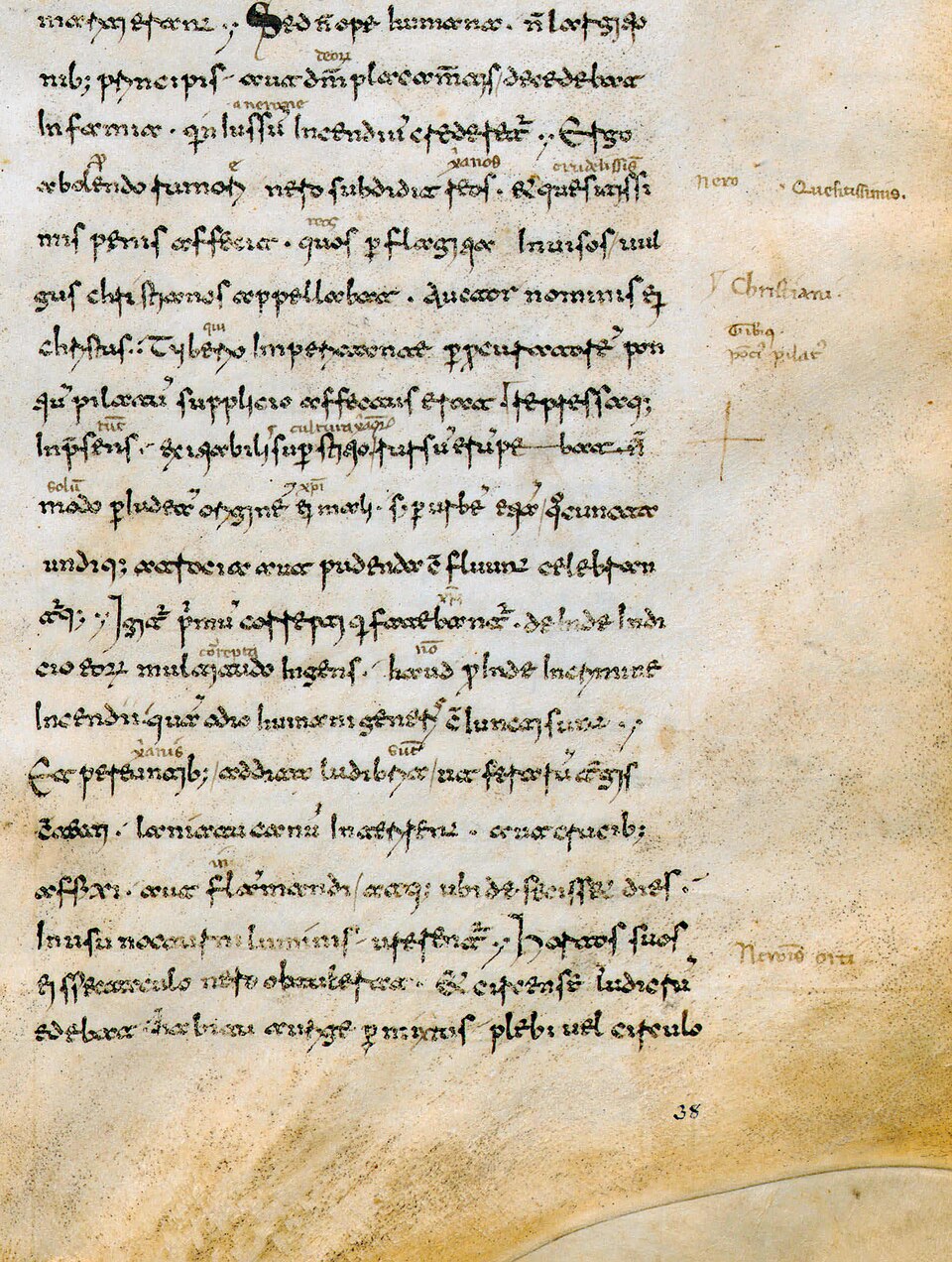
Second, the deeper point, and this one is worth sitting with. The demand for contemporary archaeological proof sounds reasonable until you learn how the ancient world actually works. Ehrman makes the observation that undoes the whole objection: we have almost no archaeological record for virtually anyone who lived in that time and place. No inscriptions, no papers, no physical trace for the ordinary and even the moderately notable. A crucified provincial teacher making no impact on Rome's bureaucracy is exactly the person we would expect to leave no monument. The absence people point to is not the absence of Jesus. It is the absence of nearly everyone.
Why historians are convinced anyway
If not Roman paperwork, then what? The case rests on the kind of evidence historians actually use for the ancient world.
The sources are early. Paul's letters were written within roughly twenty to thirty years of the crucifixion — and Paul says he personally met Jesus' brother James and the disciple Peter. That is not legend accreting over centuries; that is a man writing about people he shook hands with. The Gospels, whatever else you conclude about them, are biographies written within the lifetimes of people who would have known.
And there is a subtler argument, the one historians find quietly decisive: the criterion of embarrassment. Inventors of a hero do not saddle him with humiliations. Yet the Gospels report that Jesus came from Nazareth, a nowhere village; that he was baptized by John, implying John's seniority; that he was executed by the most shameful method Rome possessed. These are not the details you fabricate for a messiah. They are the details you are stuck with because they happened.
What this does and does not prove
Now the honest limit, because overclaiming here would betray the whole point of this site.
None of this proves Christianity. That a man named Jesus lived and was crucified is a historical claim, not a religious one. You can accept every word above — the Tacitus reference, the early sources, the embarrassing details — and still conclude he was a failed apocalyptic preacher and nothing more. Ehrman does exactly that. The existence of Jesus and the divinity of Jesus are different questions, and the first does not smuggle in the second.
But settling the first question matters, because it clears away a bad argument that keeps people from ever reaching the real one. “He never even existed” is a comfortable place to stop. It lets you dismiss the whole thing without engaging any of it. And it is, on the actual evidence, the one position the historians have closed off.
So the man is real. He was born, he taught, he was killed under Pilate, and something happened afterward that turned frightened followers into a movement that outlived the empire that crucified him. That is where the interesting questions begin — not whether there was a Jesus, but what to make of the one there was.
New writing every weekday, and a chapter of Scripture every morning.
Get The Morning Proof